
High-consistency refining represents a crucial unit operation in chemical pulping, semi-chemical pulp processing, and fiberboard manufacturing. Executing this process efficiently demands precise coordination among plate geometry, metallurgy, equipment specification, and operational controls. HUATAO Company manufactures high-consistency refiner plates ranging from 44 to 68 inches in diameter, supporting daily processing capacities from 90 to 450 metric tons under demanding industrial environments.
Selecting appropriate refiner plates requires an evaluation of process requirements alongside mechanical hardware specifications. A thorough assessment includes the following key dimensions:
Furnish and Slurry Characteristics: The raw material type, fiber origin, inlet consistency, and stock delivery condition directly influence the required bar/groove dimensions and refining intensity.
Target Fiber Morphology: Defining process priorities—such as fiber flexibility, dispersion, fibrillation, or strength development—dictates the configuration of working zone teeth.
Equipment Hardware Compatibility: Mechanical dimensions, disc rotation, mounting interface, motor power rating, and operating RPM must strictly match the original manufacturer specifications.
Throughput and Load Capacity: Refiner plate sizing must correspond to operational output requirements and system hydraulic limits.
System Pressure Tolerances: For pressurized applications operating up to 8 bar, the complete refining loop—including housing, mechanical seals, and fasteners—must be rated for continuous pressure duty.
Wear and Impact Resistance: Utilizing specialized wear-resistant alloy formulations safeguards refiner plates against unexpected shock loads and abrasive contaminants.
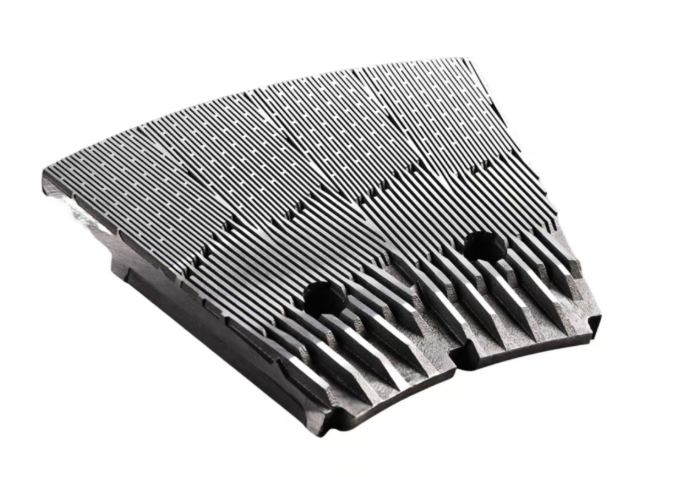
The functional geometry of refiner teeth determines energy transfer and stock behavior within the refining zone. Rather than using universal patterns, specific tooth configurations are selected based on material response:
Bar and Groove Configuration: Governs slurry flow distribution and inter-fiber friction.
Tooth Orientation: Must align with rotor rotation direction and anatomical plate positioning.
Open Flow Area: Controls volumetric throughput capacity and prevents stock accumulation.
Working-Zone Geometry: Directly affects fibrillation quality and specific energy distribution.
Achieving stable, vibration-free operation under high pressure necessitates disciplined installation checks and controlled startup sequences:
Plate Verification: Inspect segment markings, rotation orientation, alignment patterns, and diameter against engineering drawings.
Surface Preparation: Clean all mounting faces thoroughly to eliminate debris that could cause misalignment or uneven mechanical stress.
Component Inspection: Discard segments exhibiting visible cracks, structural distortion, or severe transportation damage.
Sequence-Based Mounting: Fasten teeth segments in the specified order to preserve dynamic balance, adhering strictly to recommended torque standards.
System Pressure Clearance: Verify that all auxiliary components—including seals, safety interlocks, control valves, and pressure piping—are fully certified before applying operational loads up to 8 bar.
HUATAO Company Technical Support:
Email: Lucy.chai@huataogroup.com
WhatsApp: +86 15373883537
www.refinerdisc.com
can not be empty
can not be empty

HUATAO GROUP - REFINER PLATES
ADD : No.298 Zhonghua North Street, Shijiazhuang 050000 China.
TEL : +86 0311 80690567
EMAIL :Lucy.chai@huataogroup.com
Web: www.refinerdisc.com
 WhatsApp & WeChat : +86 15373883537